
Symphonic music in Estonia dates back over 100 years, with the first compositions by Estonians including Rudolf Tobias's Julius Caesar, Artur Kapp's Don Carlos, and symphonic compositions by Heino Eller and Eduard Tubin. In recent decades, Estonian symphonic music has developed hand-in-hand with the growth of the Estonian National Symphony Orchestra (ERSO). The Orchestra has also presented the premieres of works by well-known Estonian composers Eduard Tubin, Eino Tamberg, Lepo Sumera, Arvo Pärt, Erkki-Sven Tüür as well as many others.

The ERSO traces it roots to December 18, 1926, the first concert broadcast by Tallinn Radio. The broadcast concert was performed by an ERSO predecessor, a trio headed by Hugo Schütz. The ensemble's ranks grew steadily, and by 1939 the Radio Broadcasting Symphony Orchestra included 39 performers. In addition to radio concerts, the public enjoyed live symphonies presented by the orchestra in conjunction with guest artists from the Estonia Theatre. Conductors directing the orchestra included: Raimund Kull, Priit Nigula, Juhan Aavik and Arkadius Krull, with several prominent guest conductors adding to the in-house talent.

In 1939, one of Estonia's most outstanding musical figures of the day, Olav Roots, accepted the role of orchestra director. With Roots as director, the Orchestra continued to perform symphonies in Tallinn throughout the WWII period. In 1942 a sinfonietta was formed of those musicians mobilized to Yaroslavl. It was with this sinfonietta that the distinguished conductor Roman Matsov began his career. In Autumn 1944, having returned to Tallinn, the sinfonietta united with the radio symphony orchestra, led by Paul Karp from 1944 - 1950.

In the post-war years, the Orchestra was directed by Leo Tauts, Sergei Prohhorov and Roman Matsov, who was principal conductor from 1950-1963. By 1956 the Orchestra had 90 members. Despite the Soviet repertoire policy of the time, Maestro Roman Matsov managed to also bring oratorial works by such greats as Bach, Händel, Mozart and Beethoven to the public. For the first time in what was then the Soviet Union, Matsov also managed to give audiences the listening pleasure of works by Stravinsky, Schönberg, Webern, Orff and others. It was not unusual for the Tallinn audience to be among the first to hear symphonies by D. Shostakovich; Tallinn was usually the third venue, only preceded by premiere performances in Moscow and Leningrad.

Neeme Järvi joined the Estonian Radio Symphony Orchestra in 1960, where he continued as principal conductor from 1963-1979. Under Neeme Järvi's direction, the Orchestra's repertoire expanded markedly, as did its activities. Much to the delight of the public, concert tours became a regular part of the season; music recordings and broadcasts came alive with new vigor, also to the benefit of Estonian Radio and the record company Melodija.

In 1975 the Orchestra was renamed the Estonian National Symphony Orchestra. . One year later, the ERSO collaborated with Estonian Television and Estonian Radio to present the regular concert series "Studio Hour with the ERSO" featuring classics as well as newer works by Estonian composers.

From 1980-1990, Peeter Lilje was appointed principal conductor. Under his direction, the Orchestra continued its radio concerts as well as recorded numerous volumes of both Estonian and World music. During Lilje's tenure, Tobias's oratorio Jonah's Mission was also premiered before the Estonian public.

German-born Leo Krämer joined the ERSO as principal conductor for two seasons, 1991-1993. The otherwise joyous occasion of reopened Estonian borders also brought a taste of the bittersweet in the early 1990s. New opportunities also opened before our musicians; nearly half of the Orchestra's members discovered better career opportunities in the West, or even with our neighbors to the North - the migration marking a lull in the Orchestra's history.

By the time Arvo Volmer was made principal conductor in 1993, the Orchestra had reached a low-point. But his eight seasons (1993-2001) with the ERSO proved successful. Volmer managed to create what was in essence an almost entirely new orchestra. Also noteworthy is the tremendous work done in CD recordings during Volmer's tenure.


ERSO Today

From the season 2001/2002 the principal conductor and music director of the Estonian National Symphony Orchestra is a renowned performer of St. Petersburg's new school of conductors, Nikolai Alexeev.

While Alexeev's first experience with the ERSO was as a guest conductor in 1983, the relationship has become a much closer one since 1995. In January 2003 we celebrated the 20th anniversary of Nikolai Alexeev's and ERSO's collaboration.

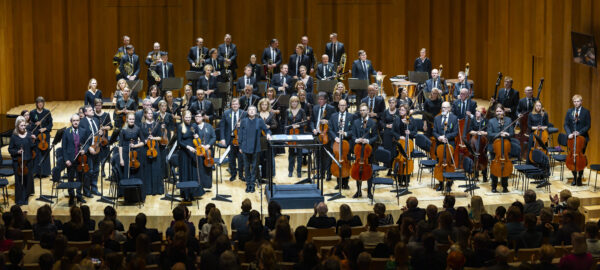
For decades, the Estonian National Symphony Orchestra has been the sole professional symphony orchestra in Estonia. Today the Orchestra has 100 symphonists. The average season includes 60 concerts. The ERSO records music for Estonian Radio regularly, and has also worked with such recording companies as: Virgin Classics, Alba Records, BIS, Antes Edition, Globe, Signum, Ondine, Finlandia Records, Consonant Works, Melodija and others. In 2001 the ERSO was registered as an independent music organization.

This season ERSO has its own resident composer Tõnu Kõrvits (the post before held by Eino Tamberg, 1997/98 and Raimo Kangro, 1998/99).

ERSO Abroad:
October 2003 - 17 concerts in Italy
Conductor Nikolai Alexeev

July 2002 - Concert in International Organ music Festival in Nürnberg (Germany).
Conductor Arvo Volmer

August 2001 - Three concerts: in Copenhagen (Town Hall Square), in Göteborg Opera and in Oslo' Konzerthaus.
Conductor Mark Robinette (USA)

February 2001 - Concert tour in Sweden (Stockholm, Göteborg, Halmstad, Växjö, Jonköping)
Conductor: Vello Pähn, soloist: Bengt-Åke Lundin (Sweden)

October 2000 - Concert tour in Germany (Bad Homburg, Trossingen, Tübingen, Müllheim, Villingen, Rüsselheim)
Conductor: Arvo Volmer, soloist: Ilari Ilja

September 2000 - Concerts in Riga, Latvia and Vilnius, Lithuania
Conductor: Arvo Volmer, soloist: Ivari Ilja

June 2000 - Dalhalla Summer Music Festival, Sweden
Conductor: Arvo Volmer, World Festival Choir

Previous ERSO performances abroad have included Yehudi Menuhin's festival Gstaad Musiksommer in Switzerland, the Europamusicale festival in Munich, Germany, and performances in the Grand Hall of the St. Petersburg Philharmonic, the Grand Hall of the Moscow Conservatory; concerts in Germany, Sweden, Kuwait, Bulgaria, Rumania, Latvia, Lithuania, and elsewhere.

Past and Present Conductors
Herman Abendroth, Nikolai Malko, Igor Stravinski, Karel Anceri, Albert Coates, Carlo Zecchi, Kurt Sanderling, Arvids and Maris Jansons, Kurt Mazur, Jevgeni Svetlanov, Paavo Berglund, Leif Segerstam; more recently, Juri Temirkanov, Nikolai Alexeev, Neeme Järvi, Paavo Järvi, Jin Wang, Andrei Chistiakov, Leslie B. Dunner, Martin Yates, Alvaro Manzano, Anders Loguin, Muhai Tang, Gilbert Kaplan, En Shao, Kiyotaka Teraoka, John Storgards, Rolf Gupta, Gintaras Rinkevicius, Jorma Panula and Olari Elts, Tõnu Kaljuste, Vello Pähn, Paul Mägi, Andres Mustonen, Anu Tali, Aivo Välja, Jüri Alperten, Lauri Sirp, Mihkel Kütson and many others.

Guest Soloists
Lazar Berman, Emil Gilels, Sviatoslav Richter, Olli Mustonen, Peter Donohoe, Pierre-Laurent Aimard, David Oistrakh, Ida Haendel, Gidon Kremer, Vladimir Spivakov, Viktoria Mullova, Juri Bashmet, Natalia Gutman, Mstislav Rostropovich, Arto Noras, David Geringas, Aurèle Nicolet, Patrick Gallois, Evelyn Glennie, Kiri Te Kanawa, José Carreras, Peter Schreier, Andrea Bocelli, Sergei Leiferkus, Håkan Hagegård, etc.


Contact information:
Estonia pst. 4
10148 Tallinn
Estonia
Pho.: (+372) 614 7787
Fax: (+372) 631 3133
erso@erso.ee
Box office
(+372) 614 7760